Samagra Shiksha Approves Only Three-Quarters of What States Request
Even the funds that do get approved often go unspent or spill over into following years.
Samagra Shiksha approves less than ₹75 for every ₹100 requested by States
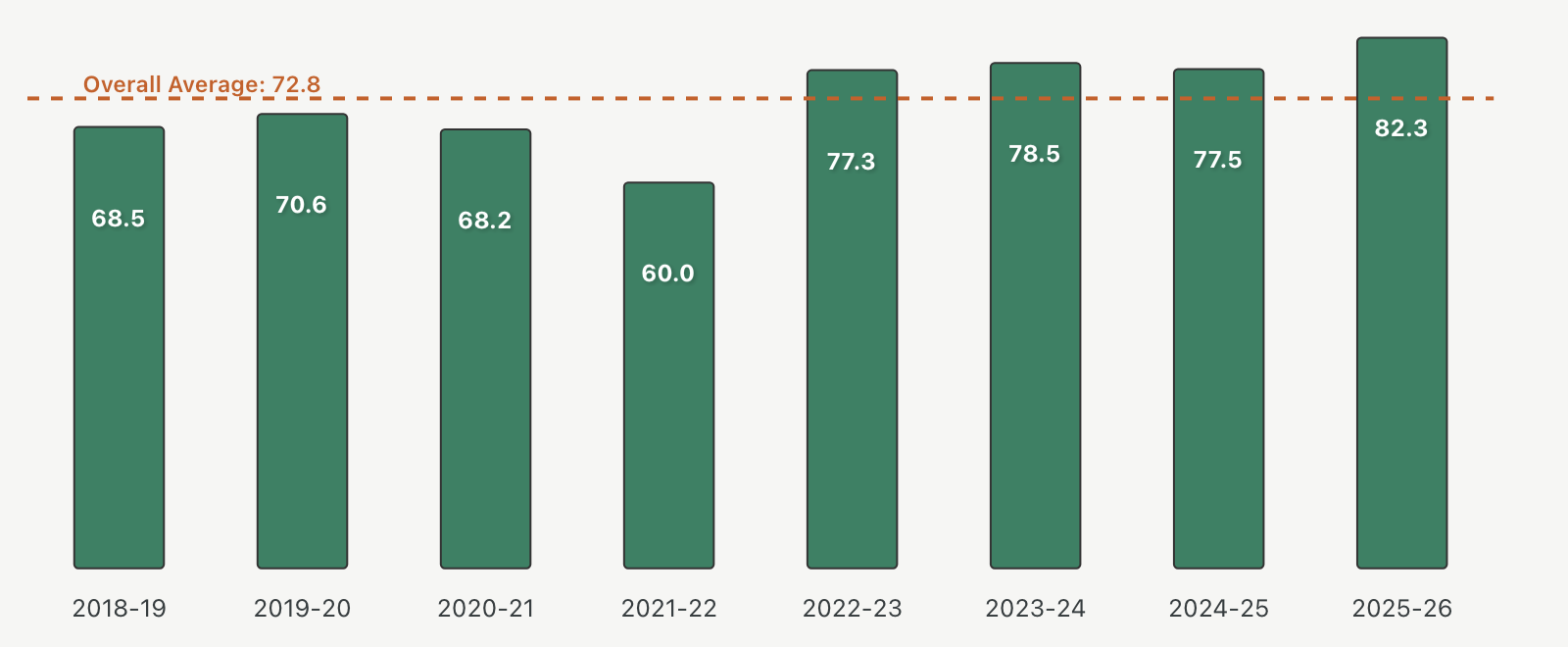
Approval percentage calculated by dividing total approved amount by total amount proposed.
Source: PAB Minutes, DoSEL
Rough Copy by thatgurjot
What do state governments want the most from the central government?
Money.
States love asking for it. And the people who run the Samagra Shiksha scheme don’t like giving away too much of it.
Aggregating the data for the last eight years, the PAB has approved ₹72.8 for every ₹100 requested by States.
There is a clear upwards trend in recent years, of course. The average approval since 2022-23 is up to ₹78.9, crossing eighty percent for the first time last year.
I’ll be honest. These numbers hide a lot more than they reveal.
There are so many moving parts in this process that it’s not fair to pin the responsibility on any one cause or stakeholder. Civil construction works take time to complete (see Delhi’s case from 2019-20). National priorities can amplify small numbers (see Lakshadweep’s case from 2022-23). And the effect political situations can have on the state’s ability to even see commitments through is almost impossible to capture cleanly in numbers.
Nonetheless, the broad strokes takeaway remains: there is a mismatch between what the states think they can achieve (the proposal) and what the PAB thinks is possible (the approval). Sometimes the states might get unfairly punished. Other times the PAB could be lauded for its foresight.
It’s democracy at play, after all.
Context: The Samagra Shiksha scheme started in 2018-19 as a consolidated centrally sponsored scheme for providing school education. Each year the scheme’s Project Approval Board (PAB) grants states and UTs a corpus for enhancing the quality of education in government schools. Both states and the PAB have to abide by the scheme’s Financial Management and Procurement Manual in this process. The minutes of these meetings along with the data on the activities, proposals and recommendations is published on the Ministry’s website.