Chandigarh Knows Its Way Around Samagra Shiksha
While some states struggle to get approvals, the UT gets 90% of its budget sanctioned on average.
What do Chandigarh, Jharkhand, Lakshadweep, Uttar Pradesh, and Tamil Nadu have in common?
They usually get over 80% of their proposed budget approved by the Samagra Shiksha PAB! That’s no small feat.
On average Samagra Shiksha approves less than ₹75 for every ₹100 requested by States
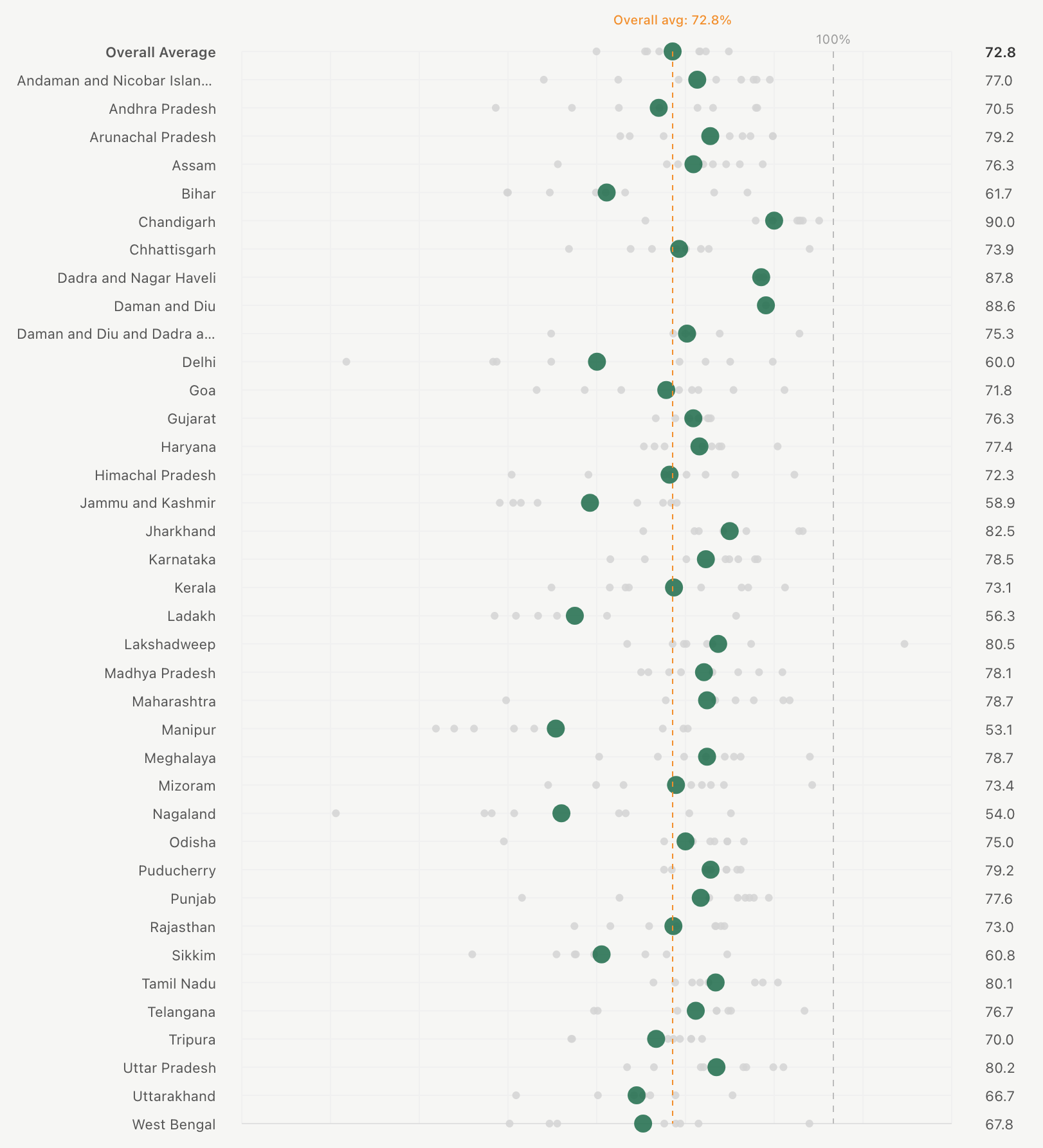
Samagra Shiksha. Amounts in Rs. Lakhs.
Source: PAB Minutes, DoSEL
Rough Copy by thatgurjot
At the end of each financial year, the Project Approval Board (PAB) of the Samagra Shiksha scheme holds a budget meeting with each state and union territory.1 This meeting serves a dual purpose:
- Take stock of the state’s educational indicators and ongoing/required activities
- Approve the state’s activities and budgets for the upcoming year2
When states propose activities for the upcoming year, they attach a budget to each item. The PAB’s job is to then decide whether this activity is suitable to be funded under Samagra Shiksha, and if so, is the proposed budget appropriate. Based on the Ministry’s own analysis, the PAB often approves a reduced (but sometimes enhanced) amount of the proposed budget.
When the percentage of funds approved (out of proposed) is aggregated over the years, we find that on average the PAB approves Rs. 72.8 out of every Rs. 100 sought by the states and UTs.
There are a variety of contextual reasons why the PAB approves a modified amount. Here are two example adding context to the outliers in the chart above.
Delhi’s Pending Classrooms
In 2019-20, the representatives from Delhi sought approval for constructing over ten thousand additional classrooms in schools upto class 8 – at a cost of Rs. 2,47,954.49 lakhs. The PAB approved Rs. 3,022.5 lakhs for constructing 150 classrooms only based on the “Gaps identified by MIS and prioritization by UT”. This reduction makes sense because civil works take a long time to complete. As possibly anticipated by the PAB, the minutes of the 2021-22 meeting shows this under Pending Works –
| Financial Year | Approved | Completed | In Progress | Not Started |
|---|---|---|---|---|
| Upto 2017-18 | 3039 | 2613 | 386 | 40 |
| 2019-2020 | 150 | 0 | 0 | 150 |
| 2020-2021 | 161 | 0 | 0 | 161 |
| Total | 3350 | 2613 | 386 | 351 |
The Delhi government in fact chose to surrender 236 additional classrooms out of the 351 pending! Interestingly, the minutes for 2025-26 show that there still are pending works for 347 additional classrooms!3
Lakshadweep’s Unexpected Gift
In 2022-23, the UT of Lakshadweep presented a budget for Rs. 6.7 crores. The PAB in its magnanimity approved a budget for Rs. 7.5 crores instead!
No, it wasn’t magnanimity, it was the Vidya Samiksha Kendra (VSK). In that year, the Ministry of Education decided that every state and UT should set up an education management information system along the lines of the VSK in Gujarat. To this end, the PAB added the setup and operational expenditure for VSK to each state’s budget.
This is how Lakshadweep ended up with an unprecedented 112% approval. The PAB had in fact slashed their original proposal, approving Rs. 5.5 crores out of the 6.7 proposed (82% – pretty good still). The additional two crores for VSK is what tipped the balance.
What is Chandigarh doing right?
It’s hard to say what is the secret for Chandigarh’s success in the PAB process but we can make some informed guesses.
Any activity proposed by the states in their annual workplan is judged by the PAB using a simple decision-tree:
- Can this activity be funded under Samagra Shiksha? For which, the activity should be within the ambit set out in the Financial Management and Procurement Manual. Sometimes an activity might overlap with other similar activities under different schemes or projects. The PAB might decide to
-
The minutes of these meetings along with the data on the activities, proposals and recommendations is published on the Ministry’s website. ↩︎
-
Or next two years, based on a recent communication by the Ministry. Not sure if it has been put into effect yet. ↩︎
-
It’s not just Delhi though. Literally every single state in the country has the exact same situation. ↩︎