Rural India Has Gotten More Expensive Relative To Urban India
The Consumer Price Index shows that prices of goods and services have increased 2 percent more in rural areas than in urban areas.
Prices in 2026 are almost twice as much compared to 2012.
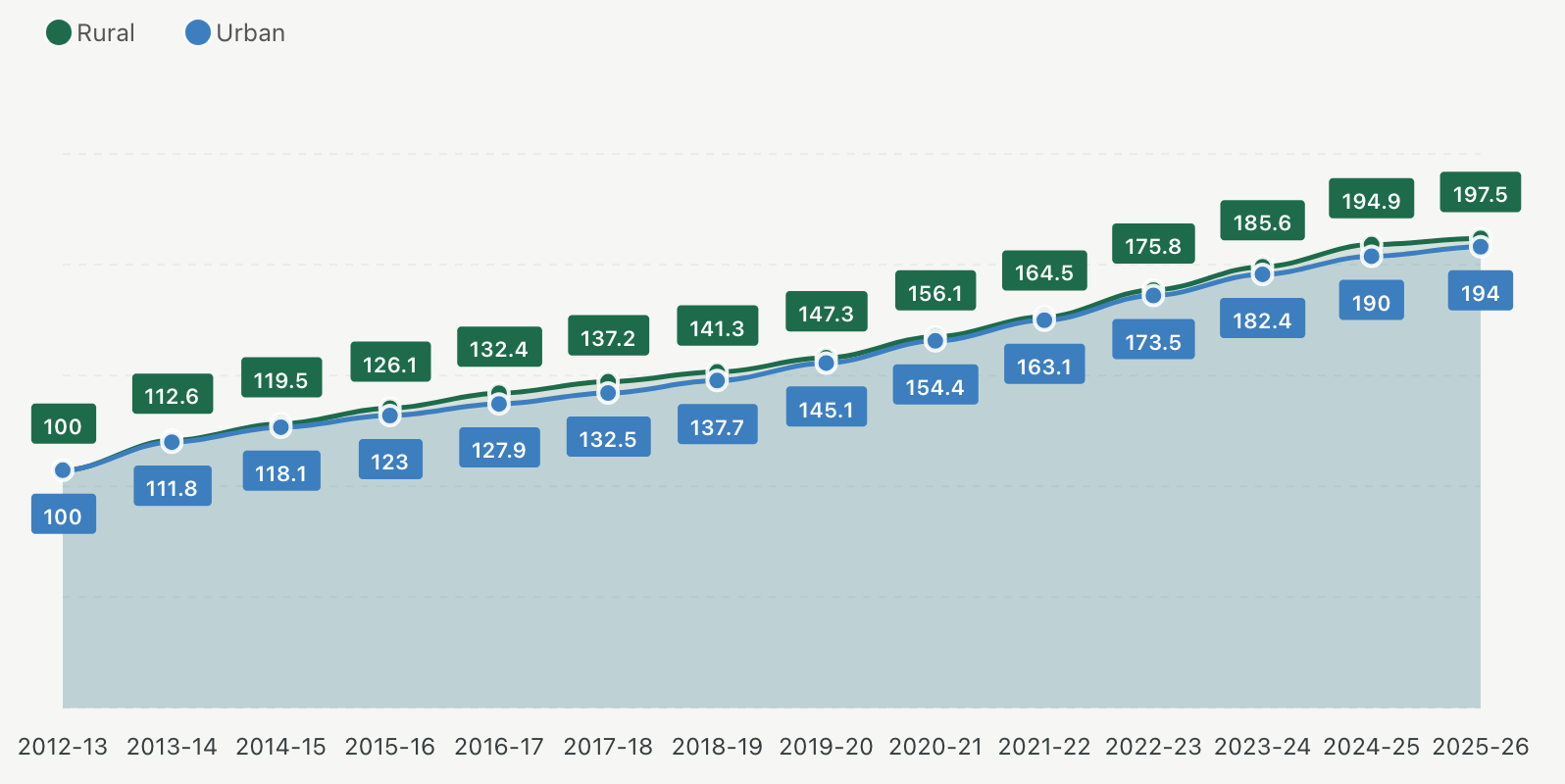
Yearly Consumer Price Index calculated by averaging the General Index values from April to March. Base 2012.
Source: MoSPI
Rough Copy by thatgurjot
Ministry of Statistics and Programme Implementation (MoSPI) publishes a monthly Consumer Price Index (CPI) for various categories such as food and beverages, clothing and footwear, housing, fuel and light etc. A General Index covers all the groups.
MoSPI defines CPI as follows:
Consumer Price Index (CPI) is designed to measure the changes over time in the general level of retail prices of selected goods and services that households purchase for the purpose of consumption. CPI numbers are widely used as a macroeconomic indicator of inflation, and also as a tool by government and central banks for targeting inflation and monitoring price stability. CPI is also used as deflators in the National Accounts. Therefore, CPI is considered as one of the most important economic indicators.
Every year from 2012-13, the CPI for rural areas has risen a few points more than that for urban areas. The biggest gap occurred in 2024-25 when CPI Rural was a full 4.9 points higher than CPI Urban.
I wonder what the implications are. Do people who straddle the rural and urban life feel this difference?
Could there be a reason in the methodology that can simply justify this difference?
I should find out if this difference exists in other countries. This article from the USA shows that inflation is hitting rural areas harder. Also, in typical American fashion – “The surveys used for CPI calculations are only conducted in urban areas.”
CPI data split for urban and rural regions seems hard to come by. India seems to be an outlier in this regard.
This paper by a People’s Bank of China researcher shows similar trends between 1995 to 2008 in China –
First, urban CPIs have been lower than rural CPI after 1995. Second, the gap between urban and rural CPI enlarged by an average of 1.03 ppt, and the gap has been increasing overtime. During 2005-2008, the gap has been more than 2 ppt, much larger than the gap of unadjusted urban-rural CPI.